Bruno Peyron / Orange II (1st)

The various attempts to break the record and to carry off the Jules Verne Trophy represent just as many ocean adventures that deserve to be told here.

 
Severe damage or overly long delays have often brought the momentums of Captains Courageous to standstills. Other skippers have succeeded in finishing their world tours… But not quickly enough to beat the established record.
 
These performances – the stories of men, women and their boats – will be recounted in these pages.
 
Come back soon!

Olivier de Kersauson / Geronimo

The various attempts to break the record and to carry off the Jules Verne Trophy represent just as many ocean adventures that deserve to be told here.

 
Severe damage or overly long delays have often brought the momentums of Captains Courageous to standstills. Other skippers have succeeded in finishing their world tours… But not quickly enough to beat the established record.
 
These performances – the stories of men, women and their boats – will be recounted in these pages.
 
Come back soon!

Olivier de Kersauson / Geronimo

The various attempts to break the record and to carry off the Jules Verne Trophy represent just as many ocean adventures that deserve to be told here.

 
Severe damage or overly long delays have often brought the momentums of Captains Courageous to standstills. Other skippers have succeeded in finishing their world tours… But not quickly enough to beat the established record.
 
These performances – the stories of men, women and their boats – will be recounted in these pages.
 
Come back soon!

Ellen Mac Arthur / Kingfisher II

The various attempts to break the record and to carry off the Jules Verne Trophy represent just as many ocean adventures that deserve to be told here.

 
Severe damage or overly long delays have often brought the momentums of Captains Courageous to standstills. Other skippers have succeeded in finishing their world tours… But not quickly enough to beat the established record.
 
These performances – the stories of men, women and their boats – will be recounted in these pages.
 
Come back soon!

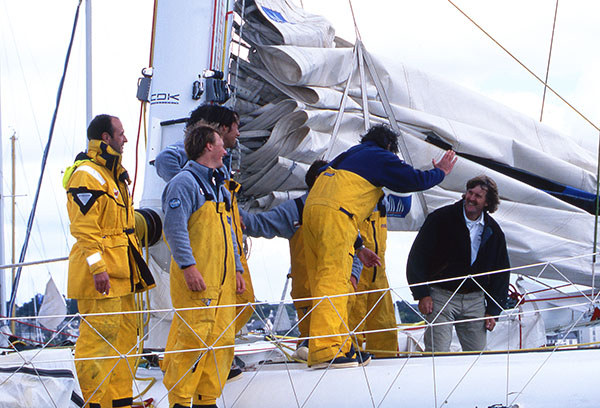
Bruno Peyron / Orange

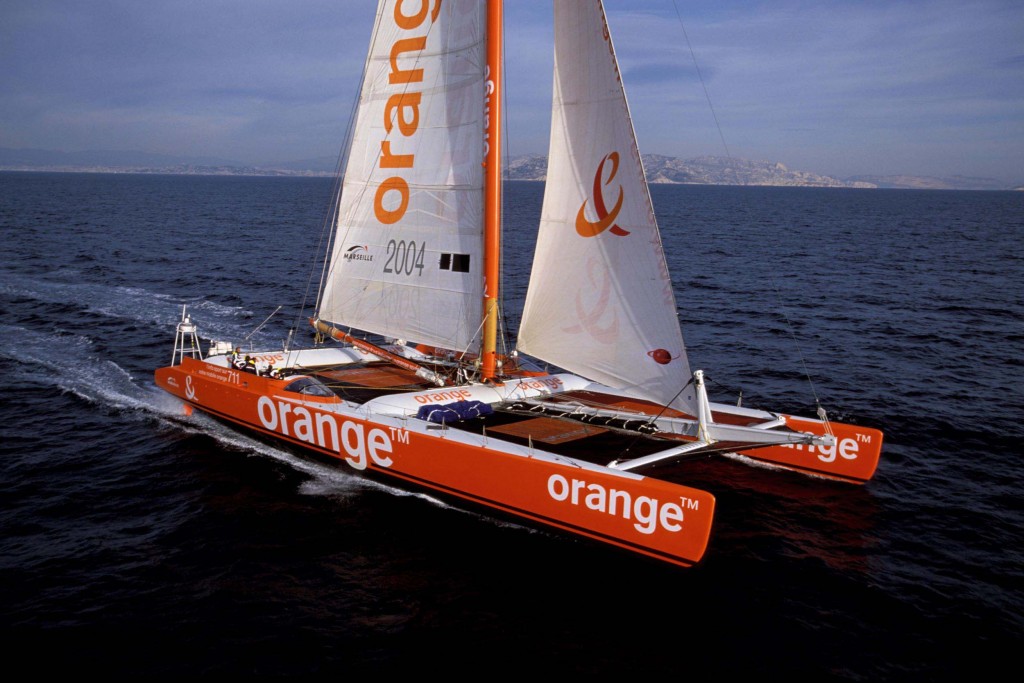
Almost ten years after his inaugural record, spurred on by Olivier de Kersauson’s performance in 1997, Bruno Peyron set off once again against Phileas Fogg’s watch. Thirteen sailors on board Orange maxi-catamaran would not be too many to thrash out this world tour. The weather was ruthless. The boat was close to breaking apart. The story of a hard-earned record… Ultimately won by sang-froid and tenacity.
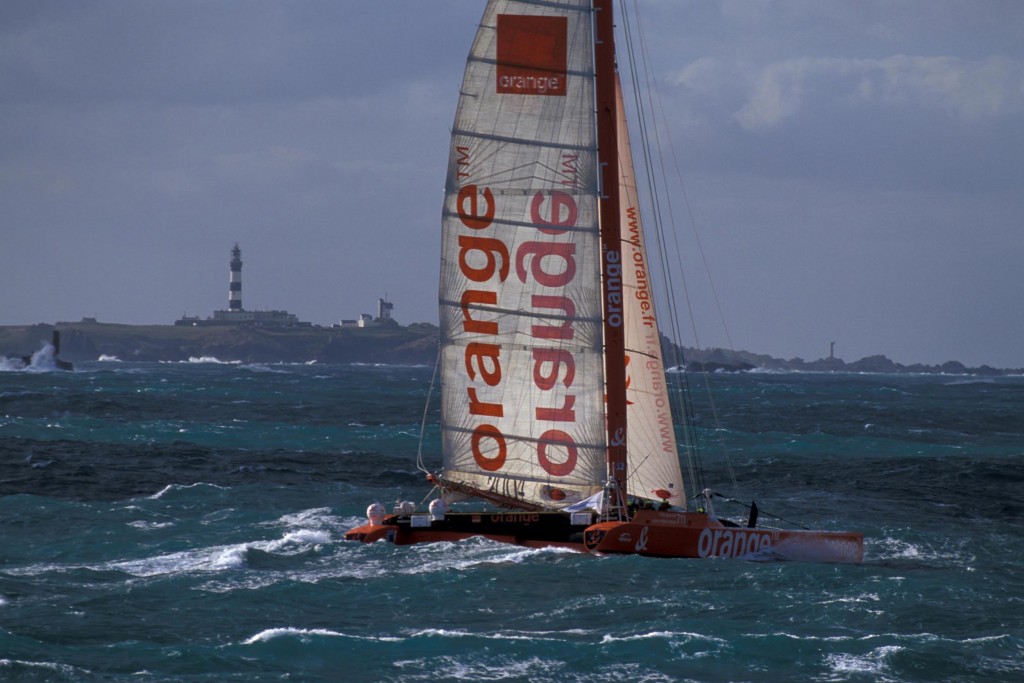
©Photo Gilles Martin-Raget © Photo Gilles Martin-Raget

On 2 March 2002, the day on which Orange set off on the Jules Verne Trophy circuit, nothing heralded a comfortable victory. Bruno Peyron’s twelve men were worried. Already tested. Their maxi-catamaran’s masthead had broken after thirty minutes of sailing, on 14 February, during a first departure. Orange had just spent a dozen days in the good hands of the Multiplast yard in Vannes, for hasty repairs.

They could no longer afford to lose any more time. Rare are the optimal weather slots for reaching the equator and attempting a circumnavigation via the three capes in the best-possible conditions. The Great South is more navigable during the southern summer– winter in the northern hemisphere. Outside this period, setting a sailing speed record in these latitudes is highly unlikely.

Orange, 33 meters, was a new incarnation of the former Innovation Explorer, already victorious on an itinerary similar to that covered by the Jules Verne. In 2001, it had carried Loïck Peyron to second place in The Race, a circumnavigation event launched by his elder brother. But on board, even if the boat inspired confidence, everyone knew only too well that she needed pampering. As Orange crossed the starting line off Brest, whipping by at 20 knots, the wind northeasterly on a choppy sea, the eyes of all thirteen sailors were riveted on the masthead.

On the eve of this second departure, the crew learned that Geronimo, Kersauson’s trimaran, had turned around just after crossing the equator, due to rudder damage. “The Admiral” who had wanted to beat his own record had no choice but to abandon the race.

Gently to the equator

Heading for the equator, Orange maintained its average speed of 20 knots with a north-northeasterly wind that soon blew in the back axis of its trajectory.
Slowed down 80 miles (148 km) from this first geographical mark, the maxi-catamaran left untouched the Ushant-equator reference time recorded by ENZA New Zealand, skippered by Peter Blake and Robin Knox-Johnston in 1994.
When Orange entered the South Atlantic on the morning of 10 March, 7 days and 22 hours after crossing the Jules Verne Trophy’s starting line, Bruno Peyron was moved by memories of Peter Blake. The skipper from New Zealand had died tragically in 2001, in these same latitudes.

The South Atlantic barrier

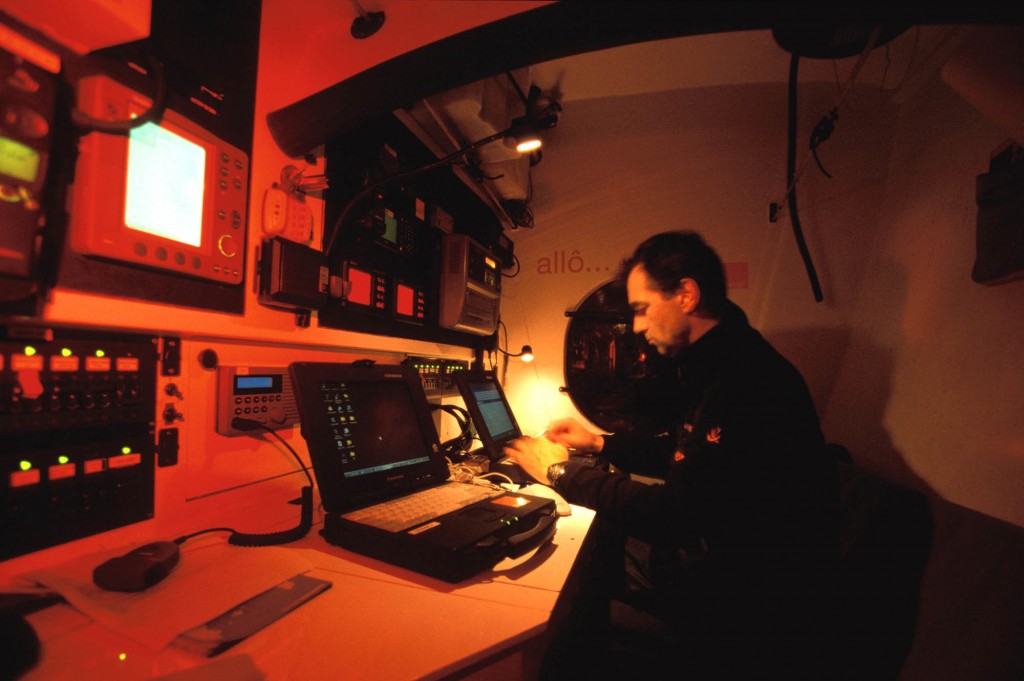
On 11 March, Orange sailed along the South American coast and attempted to go westwards to bypass the St. Helena High. But the high-pressure zone stretched right up the South Atlantic, blocking the sailors’ way. “The anticyclone is swelling up more and more and is closing the door on us from east to west,” warned Gilles Chiorri. “We’re going to use up our first jokers on this first real ordeal…”
At 29°18 south, the Orange crew hoped to get their vessel to pick up speed and veer northward. But on 15 March, Philippe Péché, while inspecting the boat at the start of his shift, noticed a shiny object on the net: it was the mainsail’s headboard! The nine men on duty got busy on the repairs. And five hours later, by the time that the headboard car was fixed, the window for the highly anticipated exit from the anticyclone was shut.
The only option in the face of this South Atlantic barrage remained passing through the oceanic ridge: tackling the calm by cutting through, direction east-southeast, the center of the high pressures, while strong westerly winds blustered around 40° south.

A pitiless Indian Ocean
©Photo Gilles Martin-Raget © Photo Gilles Martin-Raget

On 21 March, after 18 days, 18 hours and 40 minutes at sea, in conditions hostile to navigational exploits, Orange set the Ushant – Cape of Good Hope benchmark time. It thus beat, by 23 hours and 13 minutes, the record set by ENZA in 1994, and came three days ahead of the time notched up by Sport-Elec in 1997.

The entrance into the Indian Ocean, at 39° south, set the tone for the rest of the course. “The sea was absolutely terrible last night,” reported Bruno on 22 March. “We’ve had 45 knots of wind since last night!” And those 45 knots (83 km/h) would whip up to 55 knots (102 km/h) the next day. Orange surfed at almost 40 knots. And even bare-poled, it continued at 20 knots!
Éric Mas, an analyst at Météo Consult, summed up the situation: “Behind Orange, a vast high-pressure zone is generating south winds. Impossible to go down, especially due to the sea’s unruly state. In front is a “wall” of depressions whose evolution at Orange’s latitude does not augur well for the next 24 hours.”

While the wind turned more favorable as of 28 March, the sea was not yet entirely in sync with the direction required by the boat. “With 25 knots and choppy seas, Orange is hitting it hard,” recounted Peyron. It was impossible to step things up without the risk of the boat blowing apart.
Even tamed, the maxi-catamaran persisted in covering 500 miles (926 km) per day. But disturbing damage was the price to pay for this speed – the breaking of two mainsail boards, delamination of part of the hull’s aft beam, and cracking of two bulkheads in the wave-impact zone – and the crew embarked on a huge slalom to find the ideal weather system. “We must be at our third system since the Cape of Good Hope,” sighed Hervé Jan, on 30 March.

Once again, despite adverse sailing conditions, Orange pocketed a reference time: Ushant-Cape Leeuwin, in the south of Australia, in 29 days, 07 hours and 22 minutes.  Peyron’s crew had more than a day’s advance on the holder of the Jules Verne Trophy.

Pacific express
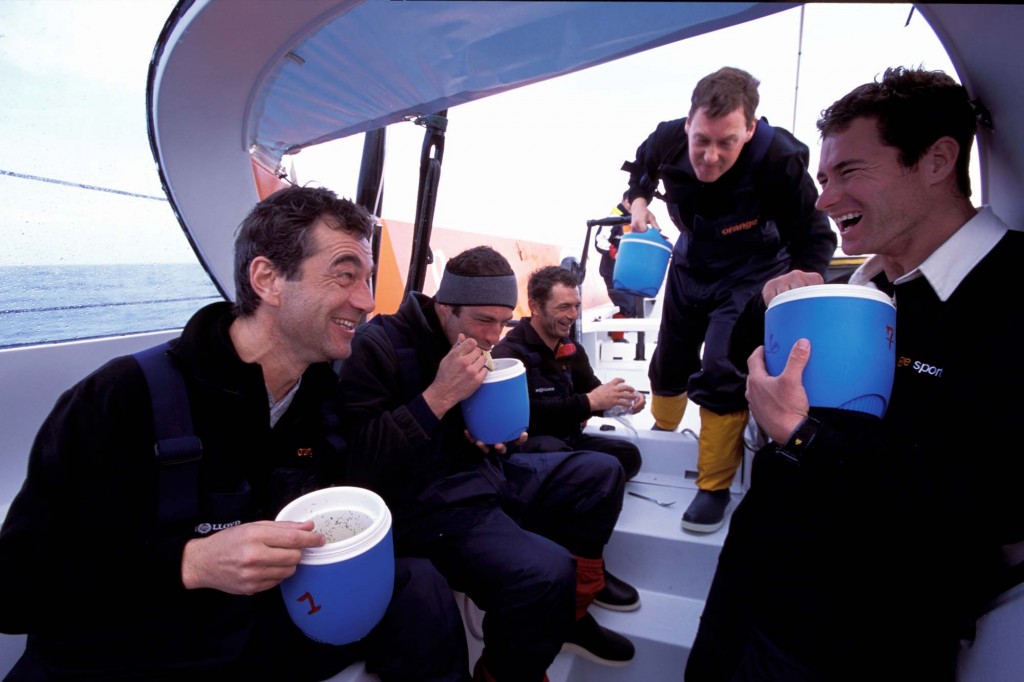
©Photo Gilles Martin-Raget © Photo Gilles Martin-Raget

On 5 April, shortly after crossing the anti-meridian at 53° south, Orange managed to change direction to head for the Great South. Now it needed to find a passage to avoid a calm zone between 50° and 60° south. In the north, the winds would be uncooperative: a wicked tropical low was forecast. The maxi-catamaran finally managed to pass below, downwind, using strong westerly winds that encouraged a cracking pace, boosted by a long swell.

The rediscovered headiness of fast speed and straight tracks – directly to the Horn – was interrupted by a cry of alarm on 10 April: “Iceberg straight ahead!” Through the fog, Philippe Péché, on the tiller, made out 3 miles (5 km) ahead, a block of ice the size of a cargo ship. Under staysail and single-reefed main, the maxi-catamaran was headed straight for it. The radar unnervingly tripped out at the same moment.

Yet it was not the Great South icebergs that would stop Orange, but the tropical low that arrested the attention of all hands on board during this crossing of the South Pacific. On 12 April, at 57° south, the low “bounced the boat from wave to wave and risked breaking something,” said Bruno Peyron. The mainsail was lowered, the gennaker rolled up and tucked away, the storm jib hoisted. “It’s a bit of a shame that our version of the Pacific Express is ending this way,” regretted the skipper. “But we’re here to bring back the Jules Verne Trophy and nothing else!”

Bruno Peyron’s choice to play the card of prudence since the start of the trip paid off. On 13 April, with four days on Olivier de Kersauson’s passage in 1996, the Orange crew crossed, in rainy conditions, the longitude of the last major cape marking the Jules Verne Trophy, the formidable Horn.

The Pacific Ocean was crossed in a record time: 12 days, 19 hours and 30 minutes. There were days in which Orange covered over 600 miles (1111 km) and it reached a peak of 39.7 knots. “She’s still intact after 42 difficult days at sea,” rejoiced the skipper.

Holy Mother, pray for us…
©Photo Gilles Martin-Raget © Photo Gilles Martin-Raget

The trip up the Atlantic forced the Orange crew to confront a new weather phenomenon: the complicated crossing of an anticyclone, with the threat of a violent low. Over eight days, Orange traced a long eastward trajectory, far more easterly than those followed by Jules Verne competitors at the time. The usual route was lengthened by 23%. But the low was well and truly avoided, and its 60-knot (111 km/h) winds skirted by 20 miles (37 km). The shortest way through the anticyclone was taken. On 22 April, Orange met the southeasterly trade winds that would carry it to the mouth of the Doldrums.

The passage of the equator, two days later, was the occasion on which Bruno Peyron announced much less encouraging news: “The titanium ball, 12 cm in diameter, that supports the 1,200 kg of the mast and rigging, with compression sometimes equal to over 60 tons, has cracked in its lower part around 170°. If it breaks, the mast will fall.”

The skipper decided to pursue the adventure nonetheless. The weather was hopeful. But if the boat were to return to Brest in one piece, it would now be necessary to avoid sailing into headwinds or against the swell at any cost. The crew also counted on chance and on bringers of luck including the sailors’ allies… “Tell our Marseilles friends to light a candle to the Holy Mother for the foot of our mast!” urged Bruno Peyron, during his radio séance on 26 April.

Did the patron saint of Marseille, Orange’s host port, hear the skipper’s request? The boat persevered, clocking up 460 miles (851 km) per day, and headed due north towards the Azores, avoiding the Azores High by the west. It even shortened the route followed in 1997 by Olivier de Kersauson.

Sailors, to the polls!

On land, another duel was being fought out: the French presidential election. On Sunday 5 May, Jacques Chirac was up against the far-right candidate, in the second and final round of the elections. French people made their resistance of extremism known in the streets. “As sailors, lovers of nature and freedom, we can only add a little strength to those who’ve been in the streets in recent days… We’re doing everything we can to be in Brest on Sunday to be able to go and vote,” promised Bruno Peyron.

On 4 May, only the final stretch remained. Orange cavorted, destination Ushant, at 25 knots, on port tack, under full main and solent.
On the previous day, there had been one last fright: the large gennaker had exploded into bits.
On the night between 4 and 5 May, a final meteorological test arose: the maxi-catamaran was trapped in calm seas 150 miles (277 km) from the final point of its world tour.

The thirteen Orange crewmembers had set off concerned about the masthead, and returned preoccupied with the mast’s foot… But it was a quasi-unscathed boat that crossed the finish line of the Jules Verne Trophy on 5 May, at 16 hours, 13 minutes, 45 seconds. Over 64 days, 08 hours, 37 minutes and 24 seconds, Bruno Peyron and his crew had never yielded to doubt. At an average of 18.15 knots, they established a new benchmark time for the Ushant – Ushant itinerary via the 3 major capes, in other words 28,035 miles (52,000 km). They improved on Olivier de Kersauson’s previous record by 7 days, 5 hours, 44 minutes and 44 seconds.

The last word goes to the skipper from Brittany: “Orange has just turned a fine sporting page. To succeed a venture such as the Jules Verne Trophy, it’s necessary to have a good team, a good boat, and to know how to preserve it. Bruno Peyron succeeded in doing this. The 27-meter era is over. This is the start of a new competition and it’s here to stay for a long time.”


Olivier de Kersauson / Geronimo

The various attempts to break the record and to carry off the Jules Verne Trophy represent just as many ocean adventures that deserve to be told here.

 
Severe damage or overly long delays have often brought the momentums of Captains Courageous to standstills. Other skippers have succeeded in finishing their world tours… But not quickly enough to beat the established record.
 
These performances – the stories of men, women and their boats – will be recounted in these pages.
 
Come back soon!

Bruno Peyron / Orange

The various attempts to break the record and to carry off the Jules Verne Trophy represent just as many ocean adventures that deserve to be told here.

 
Severe damage or overly long delays have often brought the momentums of Captains Courageous to standstills. Other skippers have succeeded in finishing their world tours… But not quickly enough to beat the established record.
 
These performances – the stories of men, women and their boats – will be recounted in these pages.
 
Come back soon!

Tracy Edwards / Royal & SunAlliance

The various attempts to break the record and to carry off the Jules Verne Trophy represent just as many ocean adventures that deserve to be told here.

 
Severe damage or overly long delays have often brought the momentums of Captains Courageous to standstills. Other skippers have succeeded in finishing their world tours… But not quickly enough to beat the established record.
 
These performances – the stories of men, women and their boats – will be recounted in these pages.
 
Come back soon!

Olivier de Kersauson / Sport-Elec

It was Olivier de Kersauson’s sixth attempt. The man from Brittany was bent on setting a new world record for speed – even at the risk of seeing Sport-Elec, his gigantic trimaran, trapped by deadly ice in the Great South. With passion and persistence, he led his crew to follow the trail of Peter Blake, determined to take the title off the last winner of the Jules Verne Trophy.

So should he turn around? Olivier de Kersauson, riveted to the chart table, lit up a cigarette with the stub of the one he had just finished. Inside the captain’s mind, a storm was raging. Outside, the sea was absolutely calm, more or less flat – and this was the way it had been ever since the boat left Ushant on 8 March 1997 at 17 hours and 37 minutes.

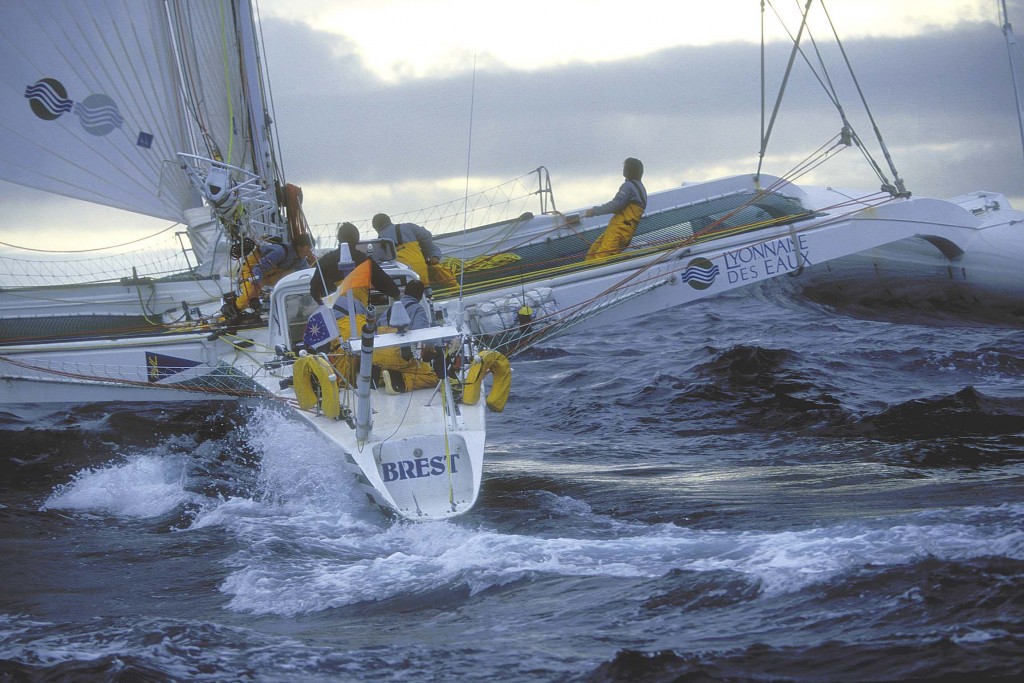
Kersauson had been waiting for this day for over two years. Two months earlier, on a first attempt in 1997, he had turned back when he was near Cape Town. At that time, Sport-Elec, his 27-meter-long trimaran, was four days behind his virtual competitor, ENZA New Zealand, winner of the Jules Verne Trophy in 1994(1)(1)In 1994, Olivier de Kersauson, on board the Lyonnaise des Eaux Dumez, crossed the Jules Verne Trophy arrival line, only 2 days and 6 hours after ENZA. It was impossible, in those conditions, to beat the record established by Peter Blake and Robin Knox-Johnston.

“Great disappointment”

Taking advantage of a brief slot when the weather was on their side, the Sport-Elec crew had just set off. But this time, if Kersauson decided to return to Ushant because of poor weather conditions, the boat would stay moored. It was already very late in the season to embark on a new attempt. The southern winter made it practically impossible to follow the optimal route that hugged the Antarctic continent. The time that had so far been lost in the North Atlantic already bode for more darkness, cold, ice, and danger by the time that they reached the Great South.

On the other side of the Atlantic, from his cottage in Maine, Bob Rice was deciphering the weather signals for the Sport-Elec crew. Olivier de Kersauson was in contact daily with this exemplary route planner who had guided Peter Blake and Robin Knox-Johnston to their record in 1994. There was nothing encouraging about Bob’s prognostics: not a single breath of wind was expected for several days to come. “The only depression within a 1,000 mile radius was in my head,” Olivier de Kersauson later recalled(2)(2)Olivier de Kersauson, Tous les océans du monde, 71j, 14h, 22’, 8’’, Le Cherche Midi, 1997.. Already, his boat lagged behind ENZA by 1,088 miles (2,014 km).
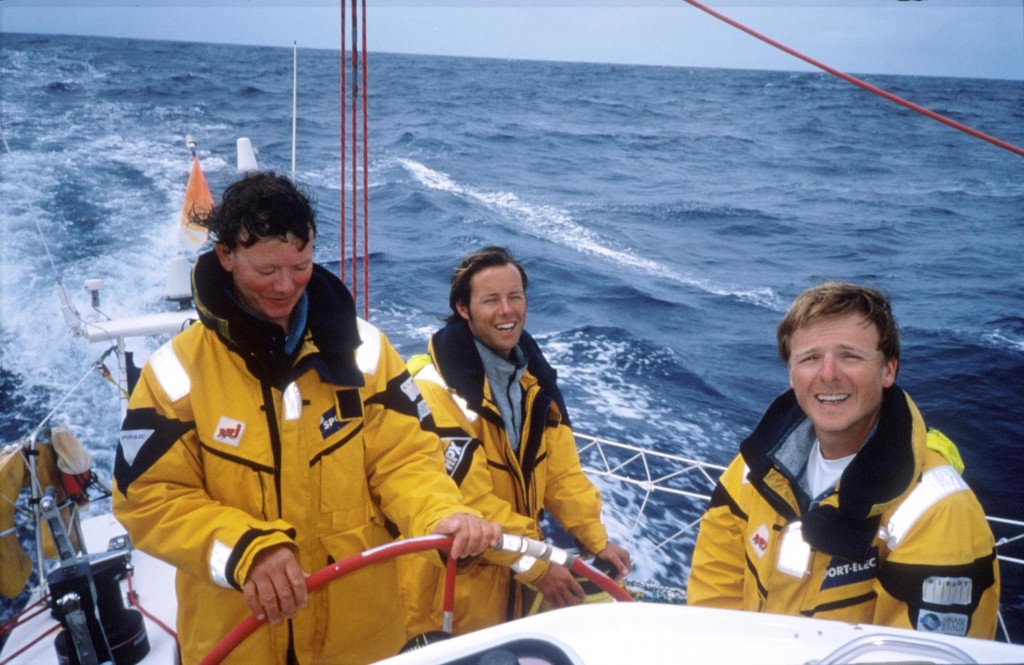
Yves Pouillaude, Hervé Jan, Didier Gainette, Thomas Coville, Michel Bothuon and Marc Le Fur scrutinized the reactions of their captain who had turned mute.
Kersauson shot a telex to his base: “Great disappointment: we’re stuck in terrible weather and I’m afraid that we’ll make the same notoriously bad time as on our first descent / It’s enough to do your head in / Still, things could be much worse / Long live motorboats.”

Archives RivacomArchives Rivacom

First record

Sport-Elec crossed the equator on 20 March, at 18 hours and 23 minutes, after eleven days at sea… and finally came across some wind. The lead of the Jules Verne Trophy holder began to diminish. At around Cape Town, Sport-Elec had only gained 200 miles (370 km) on his first attempt of the year, but the lag behind ENZA was now only 580 miles (1,074 km).
When Olivier de Kersauson’s trimaran entered the Forties after 18 days of sailing, ENZA-in-1994 was still ahead of Sport-Elec-in-1997…
Olivier de Kersauson could nonetheless still rejoice in a first record at the Cape of Good Hope: a time of 10 days, 13 hours and 27 minutes for the equator-Good Hope leg.

© Photo Christian Février © Photo Christian Février
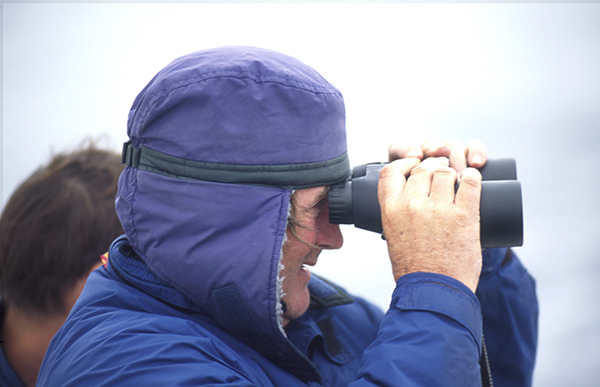
As soon as the trimaran entered the Indian Ocean, the crew adopted a medium gennaker and a tall mainsail, in a westerly flow of 20 to 30 knots. The boat kept up a fine average of 18 knots. “Going any faster in these conditions would be perilous,” commented Kersauson. The crew started to allow itself to believe that it had a chance at the Jules Verne Trophy. Whenever they changed shifts, the same burning question was asked: how much time have we taken off ENZA? How fast?

The phantom of ENZA

Sport-Elec sped ahead with the westerly wind, darting across the Indian Ocean 430 miles (800 km) further south compared to the route traced by Blake and Knox-Johnston in 1994. The New Zealand catamaran was now only 68 miles (125 km) ahead. “The ghost of ENZA, our virtual competitor, seemed to be in view… If only we could see the boat,” remarked Kersauson.

Sport-Elec roared with the shock of waves crashing over its hull. Icy wind squealed through its rigging. On board, the men kept silent most of the time. Harnessed to the deck, bundled up in their sodden oilskins, stoic when their faces were sloshed by gallons of 2°C seawater, some were experiencing the Great South for the first time. The wind persisted in staying over 35 knots (64 km/h). Inside the boat, everything was drenched and frozen. “I’ve always hated the Indian Ocean,” said Olivier de Kersauson. “Dominique Guillet died there, Deroux as well. Between 80° and 110° East, we’re massacred in the Indian.”
At 51°South and 112°East, the Sport-Elec crew spotted the first icebergs.

Archives RIVACOMArchives Rivacom

Neck-and-neck

The Cape Leeuwin longitude was crossed on 8 April 1997 at 7 hours, 7 minutes and 3 seconds. Yet another record(3)(3)Cape of Good Hope-Cape Leeuwin in 8 days, 23 hours, 17 minutes and 3 seconds.. Sport-Elec was going faster and faster, and finally left the ghost of ENZA behind it. But not for long.

Seawater invaded the slipway and drowned the motor. The power generator was beginning to falter. Without electronics, communication with Bob Rice was no longer possible, and without routing, it was impossible to contemplate the next 15 days that they would remain in the high latitudes. Kersauson was champing at the bit. Yves Pouillaude, his second, finished repairs after three days plunged in the boat’s mechanics.
The trimaran regained its spot in front of ENZA while rounding New Zealand. The longitude of Stewart Island was crossed with a ten-hour lead on Blake and Knox-Johnston.

To the ice!

Since the descent from the South Atlantic, the weather had alternated between calm spells, contrary winds and violent squalls, but no major phenomenon had impeded the trimaran’s progress. Sport-Elec’s speed remained constant, at between 18 and 20 knots.
But soon a tropical depression blocked its way. It was necessary to go further south to avoid the storm that threatened to be a violent one. Skirting around it via the north would considerably lengthen the course, and amount to giving up the trophy. Bob Rice made it clear: there was only one solution, “to go to the ice.”
Kersauson had not shaken the memory of the float of his trimaran Charal, mutilated by a growler(4)(4)A growler is a block of ice floating between two bodies of water, far smaller than an iceberg, undetectable by radars, and difficult to see with the naked eye. during his first – aborted – attempt at the circumnavigation speed record four years earlier. “Boys, till now, we’ve been playing small-time,” warned the skipper. “Now we’re going to start on the real adventure. We’re not just racing around the world now, we’re going to the real danger.” No objections came from his crew. Their captain was secretly touched. Happy to see, at this stage of the adventure, how his men had become one, with one another and with the boat.

Hervé Jan, Thomas Coville et Marc Le Fur. Archives Rivacom Hervé Jan, Thomas Coville and Marc Le Fur. Archives Rivacom
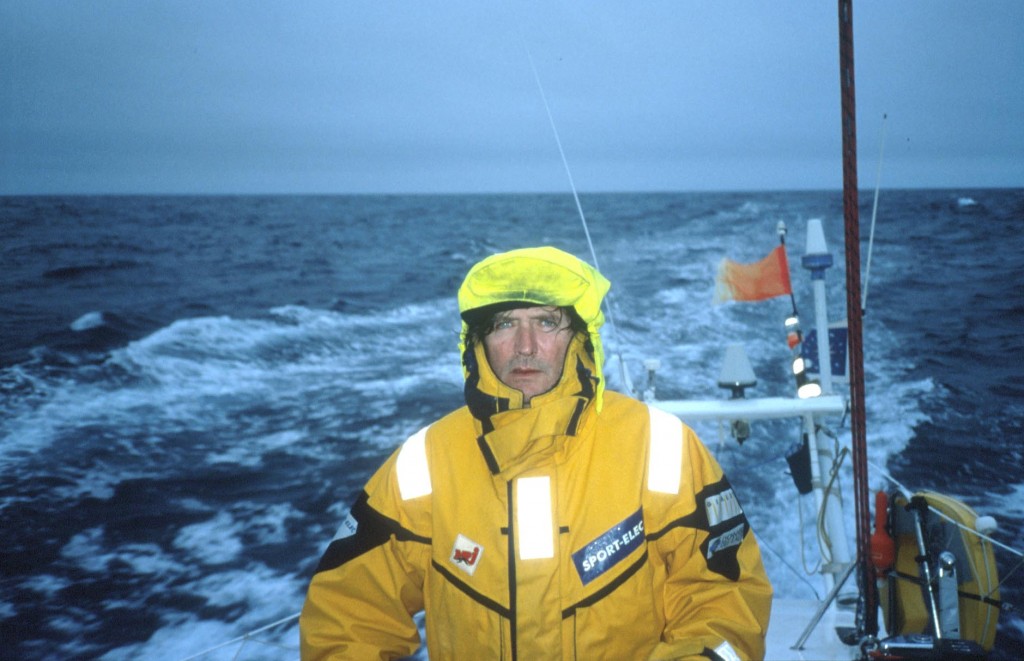
“It’s crazy, sometimes we have the impression that ENZA is here behind us,” reported Kersauson. “Then we realize that we’re alone, far from everything in the middle of the largest deserted stretch in the world. And in a field of mines or rather icebergs.”
Every hour, Sport-Elec would come across a block of ice as big as a building. It was impossible to go further north where an easterly wind would compromise the trimaran’s progress. But Bob Rice issued the order to go up when Kersauson led his men to the edge of the Southern Ocean, at 60°, 61° South. The authorized limit was 59° South. At this latitude, the water is at 3°C, any further south, growlers take twice as long to melt.

After three weeks in the Great South, the weather was good, the boat slid along on the surf… It was tempting to stick to the Southern Ocean and thus shorten the world tour. But the icy prison was closing in. It was time to head northeast, towards Horn.

Horn by night

Several days of storm and easterly wind combined to create a disturbed sea as they approached the cape. West southwesterly winds at 25 knots (46 km/h) blew in the opposite direction from the sea. The sea was choppy, treacherous. The wind offered no respite. For four days, Sport-Elec kept on jibing(5)(5)Change in tack (side from which the yacht receives wind) via tailwind., every four hours, and at this speed lost 130 miles (240 km) per day on the planned route.

On the night of 24 April, the trimaran rounded the Horn, 33 hours ahead of its virtual rival. The boat, in the axis of the sea and the wind, glided on at 26 knots.
The flash from the Cabo de Hornos lighthouse was the first light to be sighted by the crew in 30 days, signaling the first land since the Tristan da Cunha islands in the southern Atlantic.
“A show of courage and a fine lesson.” The message was signed Peter Blake. Another telex arrived on board, from Éric Tabarly: “You’ve offered us a spectacle of another world that will remain in sailing annals.”

diapos ©l'equipage + RIVACOMArchives Rivacom

Sudden death

But the race was not yet over. A large anticyclone blocked the Atlantic while the risk of a depression hovered in the south. There was no time to go eastwards towards Africa, to take advantage of the trade winds at the exit of the climb up to the equator. Sport-Elec had to hug the Falklands and then move up to Brazil on the western fringe of a small depression from Argentina… at the risk of finding itself caught between the coast and this depression. The miles ahead of ENZA, gained so bitterly in the Great South, would potentially be lost in no time at all.
The option that they took – the only possible one – proved to pay off initially. Kersauson soon announced 800 miles (1,481 km) and two days ahead of the record.
It was at this very moment that the board computer reserved for navigation succumbed to a sudden death. Kersauson came close to having a stroke. Yves Pouillaude knuckled down to implementing a plan B.

Apocalypse

The obligatory climb up along the South American coast brought Sport-Elec up against wavelets. The boat “stayed put,” the bow rising and falling against the sea. The rigging suffered, the men as well.
Off Uruguay, the wind suddenly shifted to 55 knots, then 60 knots (111 km/h). An apocalyptic storm swooped down on the exhausted crew. “We’re hauling everything down, MERDE!!!!” screamed Kersauson. Despite sailing with only a mast, Sport-Elec continued to speed on at 30 knots.
Back to calmness and wavelets on 1 May. The atmosphere remained highly charged. “We’ve been sailing on cobblestones for 3 days / No more storms, no sea either / We’re gliding, not quickly, not very high / ’Cos there’s no wind either / We’re tetchy on board / Fatigue,” admitted Kersauson by telex. ENZA was now only 500 miles (926 km) behind them.
Sport-Elec finally escaped the stillness of the Saint Helena High on 2 May, and began to gulp up miles running downwind. On 6 May, Kersauson’s crew crossed the equator for the second time at the 28°35 West longitude, snapping up two new records along the way(6)(6)Ushant-Equator (return) in 58 days, 13 hours and 39 minutes; and Cape Horn-Equator in 11 days, 20 hours and 41 minutes.. Yet the skipper from Brittany steered clear of crying victory.

“Good boating”

Sport-Elec extended its stay in the Doldrums – to such an extent that Kersauson saw the trophy slipping away from him. “Never mind,” he said, also quoting Tabarly: “We’ve done some good boating.” That was all that mattered.
Higher up, the Azores High formed an impassable barrier. ENZA had sailed far west of the European coastline to avoid it, but Kersauson preferred to head straight for France, at the risk of having to sail close-hauled in the north-northeasterly trade winds. Or approach the heart of the high.
But the skipper could breathe easy again on 14 May: his trimaran finally exited the calm waters, leaving the Azores islands on the port side. The boat’s average speed jumped up to 17 knots. With a three-day lead on Blake and Knox-Johnston’s performance, Kersauson and his men were now certain of taking out the Jules Verne Trophy.
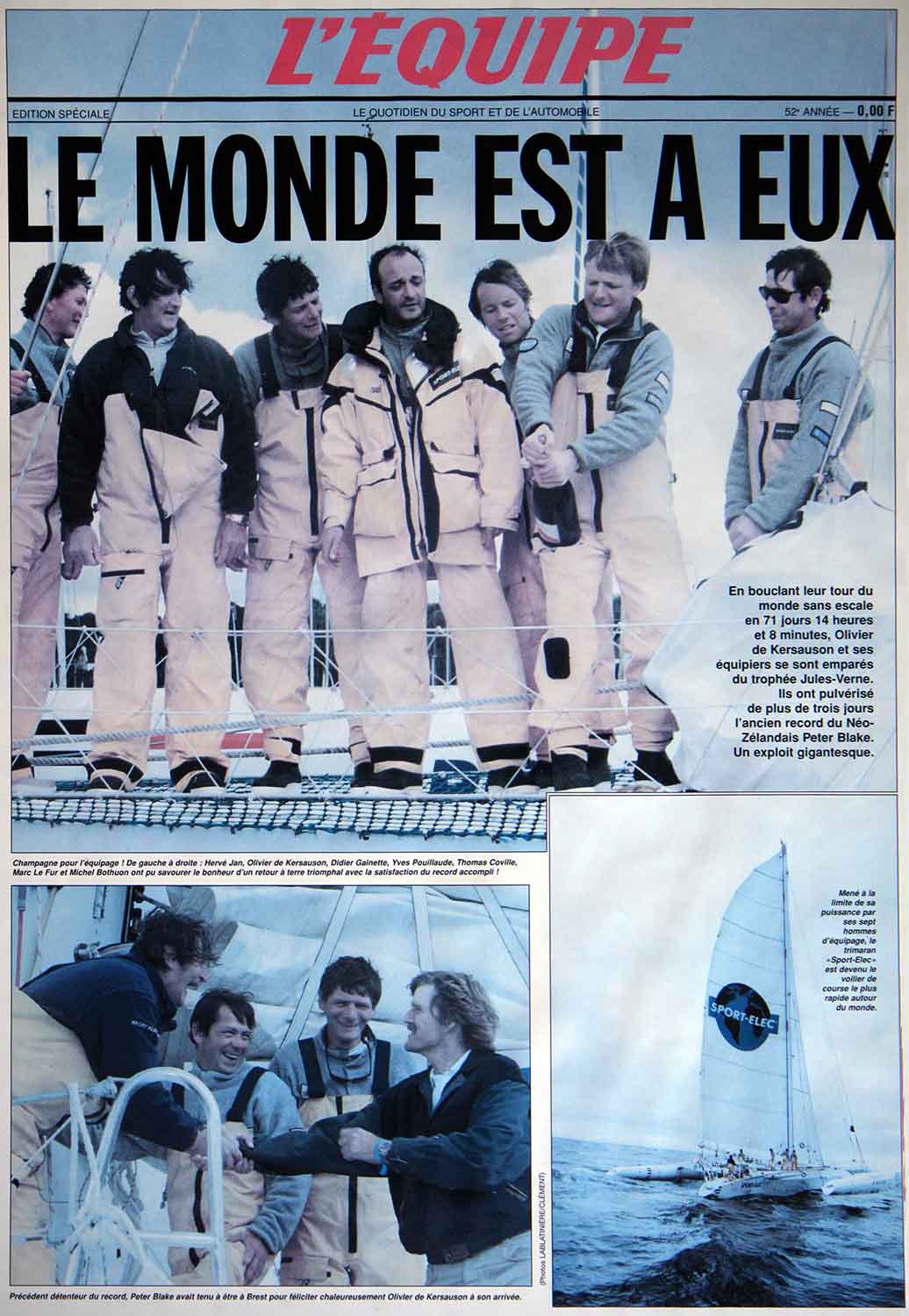
The arrival was laborious. There was no final straight for Sport-Elec but tacking up to Ushant where the downdraft of a spring tide welcomed the trimaran. Sport-Elec’s crewmembers crossed the finishing line on the morning of 19 May 1997, at 08 hours, 59 minutes and 39 seconds, with the wind at 15 knots (27 km/h). The Jules Verne Trophy was theirs(7)(7)TJV_COURSES_SportELEC_equipe small. All the boats in the world seemed to have agreed to meet to celebrate their return. Olivier de Kersauson fondly took in the string of wild islands, the bluish rock of a jagged coast, his sun-bathed Brittany. As Yves Pouillaude said jokingly: “Now we can lose our mast.”

In Brest, Sir Peter Blake congratulates ODK and his team, the news holders of the Jules Verne Trophy © Photo Christian Février